Threshold
Cost to Play and My Changing Use of Social Media

Dear Reader,
I hope you devoured my Summer series and still savor my peachy proposals with the season’s warm, slow fade. If not, catch up here, while great fruit remains available!
Meanwhile, before we launch into my Fall content together, I have a more conceptual piece for you. I hope you’ll make yourself comfortable and read—and think—through it with me, to the end.
There come times in life and work when we must re-evaluate what we do and how and why we do it. This essay is my reflection on that, shared sincerely, from my heart to yours.

Some details have been changed to protect identities.
PARTY CRASHER
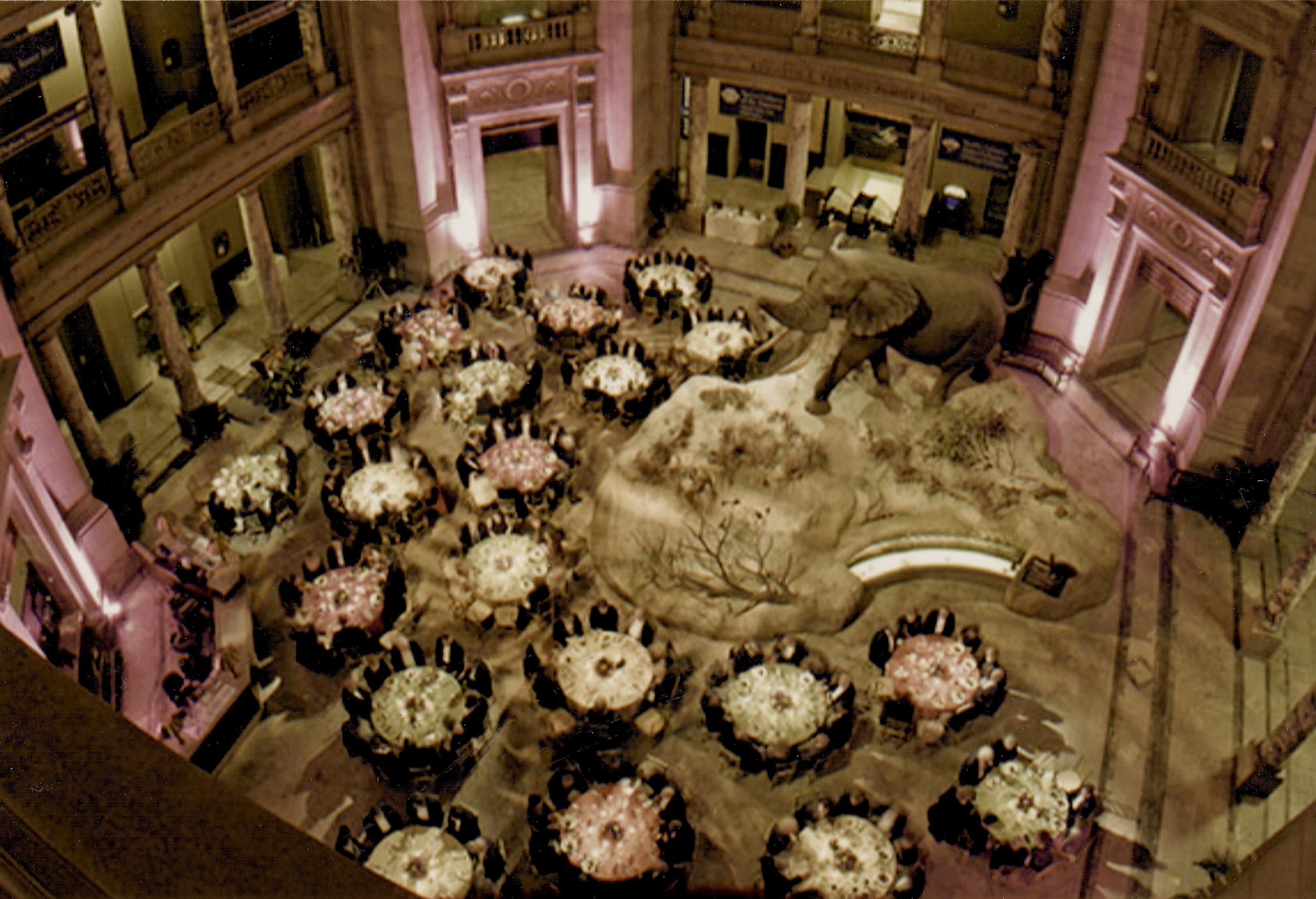
“Right into the Great Hall,” I waved, decanting tables, chairs, and precisely packed contents from tractor-trailer trucks, lined nose-to-tail down G Street.
It was blunt, sweaty work. I wore a freshly pressed suit, tie, and polished leather shoes, regardless. “Liquor, wine, and bar fruit equally distributed to the four corners,” I led, walking. “Irons, power cords, and table linens to the center floor, please and thank you! Only clean sock feet on chair cushions if you are holding a cord for an ironer,” I insisted, “And NO ONE FALL INTO THE FOUNTAIN! Guests arrive in six hours,” I clocked. “The client in five. I need you set and dressed in four-and-a-half!”
Step by heave, my nearly 150 staff laid the monumental stage for a must-see, one-night-only gala performance, and snagging entry was high society’s obsession.
The brief: 1,600 VIP guests, including 12 Directors of national museums, 19 Directors of government agencies, four Supreme Court Justices, and the American President and First Lady for standing cocktails, seated three-course dinner, performances by members of the Rock & Roll Hall of Fame, and keynote address by the President, all served in one of America’s most spectacular spaces.
The National Building Museum’s colossal Renaissance Revival façade, made in 1882 from over 15 million bricks, fills a Northwest Washington, DC, city block. Originally the Civil War Pension Building, its two-feet-four-inches-thick exterior walls are clad in a terra cotta frieze three-feet high and 1,200 feet long.
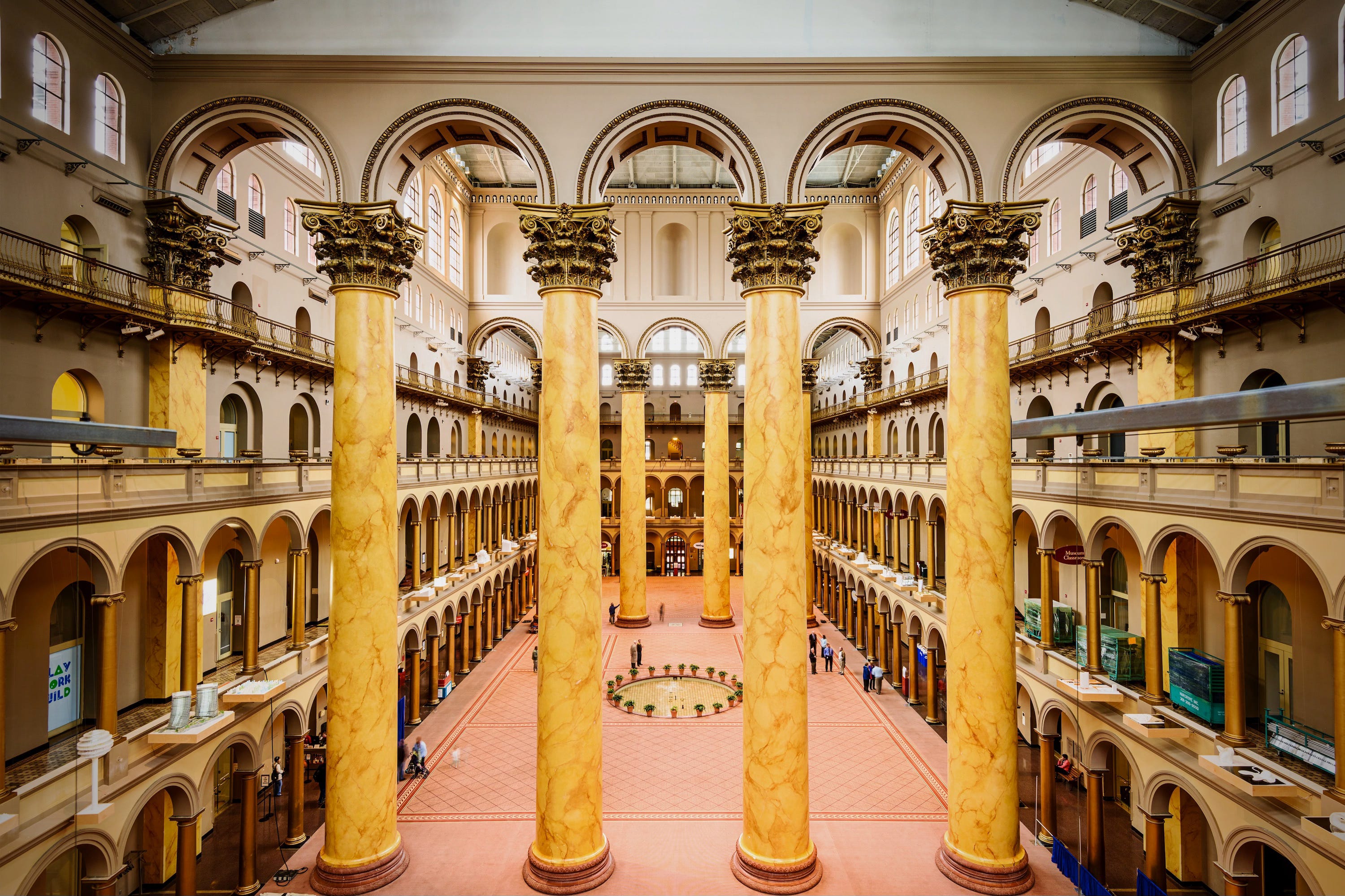
Inside, the Great Hall spans 36,656 square feet. Its metal and glass ceiling vaults to 15 stories of breathtaking open, sun-lit atrium in seemingly endless miles of arched arcades, stacked in 360-degree double galleries.
The whole pile rests on eight of the world’s largest Corinthian columns. On bases eight feet in diameter, each column soars 75 feet high, with a circumference of 25 feet. They were hand-built with 70,000 bricks each, then plastered a la Scagliola. Now, more than a century on, they’ll greet Black Tie guests in aching grandeur.
I was Maestro, caterer and event commander extraordinaire! Designing and producing over 300 major events per year, if an ingredient, furnishing, or flower was chosen, I chose it. If it happened before, during, or after one of my parties, my staff and I made it happen, without fail, in elegantly cool, scratch-made, sky’s-the-limit style.
This night, that meant 15,000 hors d’oeuvres, 12,800 crystal drinking glasses, 9,600 pieces of hand-polished flatware, 6,400 pounds of ice, 4,800 bone china plates decorated in 22-karat gold, and 3,192 David Austin garden roses to dress 200 round dining tables, plus heavy security, staff meals, loading in by lunch, and out, debris and magic whisked away, by midnight.
And that was one venue, one night. The night before, I designed and catered the wedding of an international businessman’s daughter with 450 guests, cocktail reception, and a five-course seated dinner at the palatial pink marble Beaux-Arts National Museum of Women in the Arts. The night after, I served 2,200 guests for a buffet reception at the Smithsonian National Museum of American History and a private house party in nearby Potomac, Maryland. Notes of gratitude and future bookings piled high from happy A-List clients, but something was dead wrong.
TRAINING
One month and one day after my undergraduate graduation, I reported early for my first job in Washington: junior designer and assistant to the owner of a prominent event design and production company. I was paid a pittance, plus one percent commission on all the work my boss and I sold and produced together. I had to pay too: steady obsequious tribute for my rare entrée to this exclusive club.
As my trainer dictated the company’s way of working, I asked a few questions. “You’re telling me to discard enquiries from prospective clients with modest budgets? Unless they're famous? Because we need to be seen serving prestigious clients?” I felt sure less flush callers rang because they needed our help too, but my $1,200-a-month rent (in 2004!) would be awfully steep to meet without this job. Plus, I spent my childhood watching Martha Stewart give big, professional parties on tv, dreaming I could do it as well. Beyond dreams, I made the contacts, landed the job, moved half-way across the country to take it, and I had beat trials before. So, I swallowed hard. “And you want me to sell pheasant entrées at the premium price but serve wine-dyed chicken instead? To maximize profit?”
“Look,” my trainer interrupted. “Honesty kills careers. This is only about the numbers.”
QUAM BENE NON QUANTUM
I stayed in Washington long enough to prove to myself that my skills are unusually suited to fly in the big league. I also learned that my terms of employment were unique neither to my employer nor any one aspect of the industry and my convictions were irreconcilable with the business. Advancing as far as possible with my integrity in-tact, I left.
Over the interim years, I have sought the inner rewards of making higher art, with finer skills, that exploit neither art, artist, audience, nor environment. This recently led me to another dream’s doorstep: writing my first book. However, talking with leading publishers was the typical joke. Instead of curiosity about subjects on which I have something singular to say, 100% of the internationally dominate publishers I’ve met to date invariably asked two questions: Are you on peak trend now, and how many followers do you have on Instagram?
SAME SONG, DIFFERENT VERSE
My life and work embody the flesh-and-blood questions asked by principled artists for time immemorial: perception versus reality, merit or scale, education or entertainment, and, ultimately, purpose—learning every day and creating work of real, deep quality, insight, and lasting value, by moral means, profiting enough to live.
This struggle has led myriad makers onto particularly short-form social media, like Facebook and Instagram. Many small businesses, including mine, became internationally viable by these tools, but the platforms of the past were algorithmically different from those we have now.
Big Tech has programmed its endemic conflation of luck and talent into systems that run on homogeneity and outrage. This reduces complexity and nuance to an insidious, fleeting instant gratification that artificially creates winners and losers while giving users the illusion of gain. However, in lieu of actual achievement, this illusion exploits human psychological vulnerabilities to maximize users’ time spent chasing desired outcomes on the platforms, entirely to the platforms’ favor. And the only consent we users give is our using the platforms.
PAY TO PLAY
To fry an egg, I use a skillet. To turn an egg, a spatula. To baste an egg, a spoon; but when a tool does not, or no longer, perform the function asked by the user, the intelligent user either uses the tool differently or changes to use a more effective tool.
Modern psychology classifies a person overly concerned with pleasing other people along a continuum, between emotionally immature and mentally ill. How, then, do we classify a whole society that has changed their lives and engagement with work, the world, and their fellow human to please unappeasable, ever-changing, inhuman algorithms—algorithms which, in many cases, no longer produce users’ desired outcomes?
I’ve quoted Einstein on this before, but it bears repeating: “Insanity is doing the same thing over and over again and expecting different results.” And as Marcus Aurelius noted: “The object of life is not to be on the side of the majority but to escape finding oneself in the ranks of the insane.”
We cannot use these platforms today on the memory of how they worked yesterday, for their true intent—and ours—is proven not in talk but action. The bigger question is: how much longer will we profit our abusers, hoping for the occasional kiss?
THRESHOLD
I won’t blame all society’s woes on one boogieman, but social media has tapped the vein that will bleed us to death if we let it. A key result of chronic bleeding is confusion, and confusion is one of social media’s most effective designs.
As I lately stepped back from short-form socials to consider if, or how, I will use them differently in the future, I have found clarity; and, to quote the poet Etel Adnan, “To see clearly is an act of resistance.”
What are we resisting? How is serving a vulgarian boss, a short-sighted publisher, or an insatiable algorithm different? In his classic poem Defeat, Khalil Gibran wrote our answer: “To be enthroned is to be enslaved.” This asks: what price will we pay to meet our aims, and when do we change our aims toward goals and lives we can realistically achieve, at costs we’re willing and able to manageably sustain?
Goethe wrote: “All beginnings are delightful; the threshold is the place to pause.”
In this pause, I remember my graduate class on Animal Psychology and its central theme that an animal’s intelligence is generally observed by the number of exposures to new stimuli that animal takes to learn enough to change its behavior.
As still relatively new short-form social media gleefully ladle fuel on our burning world, I wonder what openings this threshold offers us all to identify and understand the technology and its “gods” for what they are, take active responsibility for our own use of—or abstention from—these platforms and their consequences, and innovate new ways to either harness platforms’ value for real, everyday users and society or replace them with more altruistic, effective-for-users alternatives.
If anything I’ve said resonates with you, and you care about the character and integrity of the intellectual workers and businesses you support, as well as your actual social network, online and in life, I hope you’ll continue thinking on this with me. For we will only make the future we want by doing it together!
Unless otherwise noted, the ideas in this essay are mine, but they have been shaped by those of other thinkers.
For a deeper dive into the ideas I’m pondering now, read the books I’ve listed for you, below. They’ve shaped my views for this essay and my thoughts about what is happening in our world today and how we may engage those happenings ethically and productively.
I hope you find these resources as interesting and helpful as I do.
Adrift: America in 100 Charts by Scott Galloway (2022) Penguin Random House.
The Anxious Generation: How the Great Rewiring of Childhood Is Causing an Epidemic of Mental Illness by Jonathan Haidt (2024) Penguin Press.
The Death of Expertise: The Campaign Against Established Knowledge and Why it Matters by Tom Nichols (2017) Oxford University Press.
The Four: The Hidden DNA of Amazon, Apple, Facebook, and Google by Scott Galloway (2017) Random House.
Thank you Mathew for your thought provoking message. I have been telling myself that if I just use the tool correctly I will not fall prey to its darker side but your article invites me to revisit this. I have been doing some looking into what social media is actually up to and have been surprised. My naivety is no longer an excuse. Thanks for leading the way. I hope you will share with us what you find to be the antidote.